পাঁচ ওয়াক্ত নামাজের ওয়াক্ত শুরু ও শেষ সময় Expert 2026
পাঁচ ওয়াক্ত নামাজের ওয়াক্ত শুরু ও শেষ সময় is an essential topic with practical applications and significant benefits. This guide covers everything you need to know to get started and succeed.
Correctly timing your daily prayers is essential for every practicing Muslim, especially as seasonal shifts alter daylight hours throughout 2026. Knowing the precise beginning and ending boundaries of Fajr, Dhuhr, Asr, Maghrib, and Isha ensures your worship is accepted and performed within its prescribed limits.
Missing these windows without a valid reason invalidates the prayer, making strict adherence to the Islamic jurisprudential schedule a daily priority. Whether you follow the Hanafi or Shafi’i school of thought, understanding these exact calculations helps you organize your 2026 daily routine around your religious obligations seamlessly.
Key Takeaways
- Understanding পাঁচ ওয়াক্ত নামাজের ওয়াক্ত শুরু ও শেষ সময়:Essential knowledge for success in this area
- Practical applications:Real-world scenarios and proven use cases
- Key benefits:Significant advantages when implemented correctly
- Best practices:Important guidelines and expert recommendations
- Future trends:Evolving landscape and emerging opportunities
Understanding পাঁচ ওয়াক্ত নামাজের ওয়াক্ত শুরু ও শেষ সময়
The exact timing of the five daily prayers depends entirely on the movement of the sun relative to your specific geographical location. Let us break down the exact start and end parameters for each of the five daily prayers according to authentic Islamic rulings.
Fajr and Dhuhr Exact Boundaries
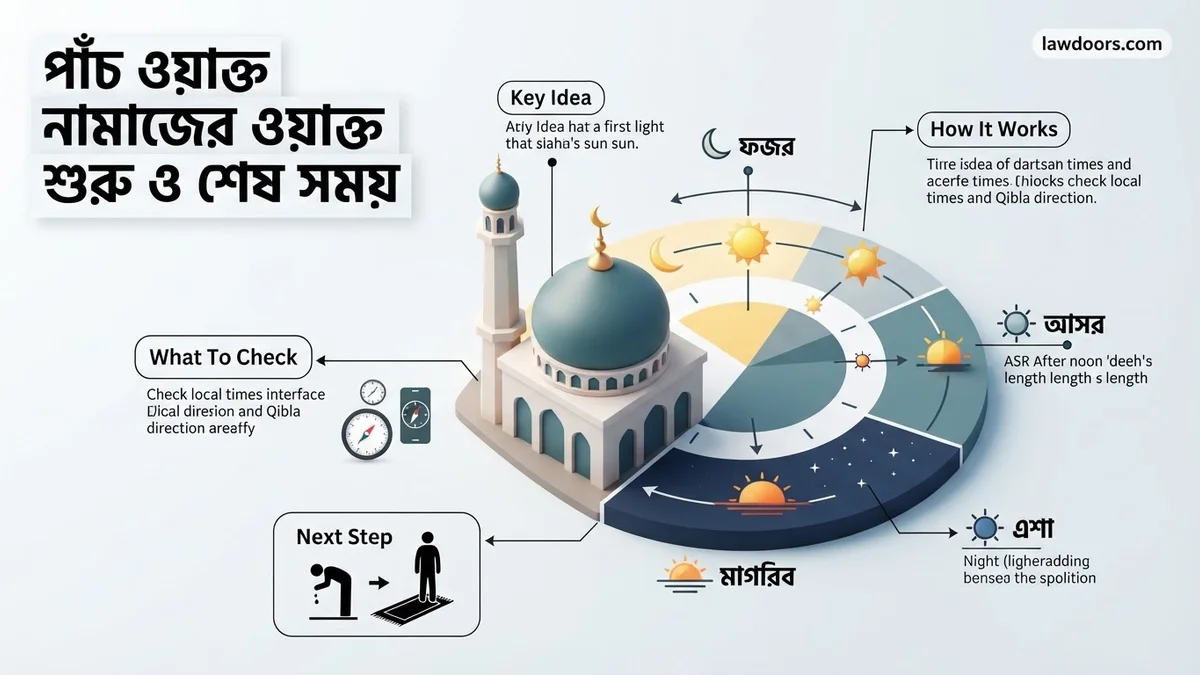
Fajr begins with the appearance of the true dawn (Subh Sadiq), which is the white light spreading horizontally across the horizon. It lasts until the very edge of the sun’s disk begins to rise. Dhuhr begins immediately after the sun passes its zenith (Zawal) and starts to decline. Its time continues until the shadow of an object equals its length plus the shadow length at midday (according to Shafi’i) or twice its length plus the midday shadow (according to Hanafi).
Asr, Maghrib, and Isha Parameters
Asr starts right when Dhuhr ends. The Hanafi ruling states Asr begins when an object’s shadow is twice its midday length, while the Shafi’i and other major schools state it begins when the shadow is equal. Asr ends just before sunset. Maghrib begins the moment the sun completely sets below the horizon and ends when the red twilight (shafaq ahmar) disappears. Isha starts immediately after Maghrib ends and lasts until the true dawn of the next day, though praying it before midnight is strongly preferred.
Key Benefits of পাঁচ ওয়াক্ত নামাজের ওয়াক্ত শুরু ও শেষ সময়
Sticking strictly to the prescribed prayer windows yields immense spiritual and practical advantages in your daily life. When you monitor the exact schedules for 2026, you build a disciplined routine that brings barakah (blessings) into your time management.
Spiritual Discipline and Compliance
- Ensuring Validity: Performing prayers strictly within their designated boundaries guarantees that your obligatory acts of worship fulfill Islamic requirements.
- Avoiding Forbidden Times: Knowing when prayer times end prevents you from accidentally praying during the three Makruh (forbidden) times, such as exactly at sunrise, zenith, and sunset.
- Enhanced Focus: Anticipating the prayer times allows you to mentally transition away from worldly tasks and prepare your heart for connection with the Creator.
Practical Time Management for 2026
Planning your work, travel, and meals around the shifting 2026 prayer windows eliminates last-minute stress. By checking local timetables daily, you can coordinate business meetings, family time, and rest periods without ever rushing to catch a closing prayer window.
Final Thoughts on পাঁচ ওয়াক্ত নামাজের ওয়াক্ত শুরু ও শেষ সময়
In summary, understanding পাঁচ ওয়াক্ত নামাজের ওয়াক্ত শুরু ও শেষ সময় is essential for success in this area. Apply these insights to see real results.
❓ Frequently Asked Questions
What exactly is পাঁচ ওয়াক্ত নামাজের ওয়াক্ত শুরু ও শেষ সময়?
পাঁচ ওয়াক্ত নামাজের ওয়াক্ত শুরু ও শেষ সময় encompasses proven concepts and methodologies that help you achieve better results. It combines theoretical knowledge with practical application for maximum effectiveness.
How can পাঁচ ওয়াক্ত নামাজের ওয়াক্ত শুরু ও শেষ সময় benefit me?
Understanding and applying পাঁচ ওয়াক্ত নামাজের ওয়াক্ত শুরু ও শেষ সময় principles improves your skills, opens new opportunities, and helps you achieve your goals more efficiently.
What resources do I need to get started?
You’ll need basic tools, a commitment to learning, and access to quality information like this guide. Start with fundamentals before advancing to complex topics.
Is this suitable for complete beginners?
Absolutely! This guide is designed to take you from beginner to proficient. Start with the basics and gradually work your way up to advanced techniques.
How do I measure my progress?
Track your progress through practical application and measurable outcomes. Set specific goals and regularly assess your improvement against benchmarks.
Where can I learn more after this guide?
Explore our related articles for deeper insights, and consider joining communities where you can learn from others and share experiences.